AI & Automation
8 min readHow to get recommended by ChatGPT: a guide for local businesses
Learn what ChatGPT draws on when it names a local business, and the practical steps that make your business easier to recommend.
How to get recommended by ChatGPT matters more each month to owners of local and service businesses, because a prospect who asks an assistant for a plumber, accountant or clinic may get three names and never see yours. If the assistant has never heard of you, you are not on the shortlist, however good your work is. This guide sets out what the tools draw on, the steps you can take, and what you cannot control.
How to get recommended by ChatGPT: what it actually draws on
ChatGPT builds its answers from several places. IMPACT describes a mix: a core language model trained on public internet content, real-time browsing or plugins in premium versions, structured sources such as Google Business Profiles, online reviews and directories, and authoritative content seen during training (IMPACT).
Two separate problems can look identical from the outside. Either the model has no training data about your business, or it cannot retrieve a current page about you when it answers. A discussion on Reddit's r/RankWithAI makes this point and notes that the two need different fixes and take different amounts of time (Reddit, r/RankWithAI). We cannot give you a timeline, because it depends on which problem you have and how the tool behaves. What you can do is make your business easy to find now and easy to recognise later.
Most advice on AI visibility is written for software companies and content sites. A local business is different. The question is usually 'who does this near me', and the sources that answer it are listings, maps, reviews and local directories. ClickForest names reviews, third-party listicles, LinkedIn and editorial media as the sources ChatGPT recommends from that you can influence (ClickForest). Start there.
Where ChatGPT gets its answers
Learned from training
Core model trained on public internet contentAuthoritative content seen during trainingLooked up live
Real-time browsing or plugins in premium versionsStructured sources
Google Business ProfilesOnline reviews and directoriesMake your business listings consistent everywhere
The assistant needs to be confident it is looking at one business. If your name, address and phone number appear in three different forms across the web, it has to guess which one is correct. Petal and Bloom Tech Marketing gives the same advice: keep your details the same everywhere (Petal and Bloom Tech Marketing).
Write one master sheet before you touch anything. Include your exact trading name, your address as it should appear, one phone number, your website, opening hours, and a two-sentence description of what you do and where. Then check every listing against it: Google, Apple Maps, Bing Places, Facebook, and the directories your customers actually use in your trade. Fix the differences you find. Small things matter here.
Claim and optimise your Google Business Profile
IMPACT lists claiming and optimising your Google Business Profile as the first practical step to being recommended by ChatGPT (IMPACT). It is also the listing most of your local prospects will see first, so it earns the time.
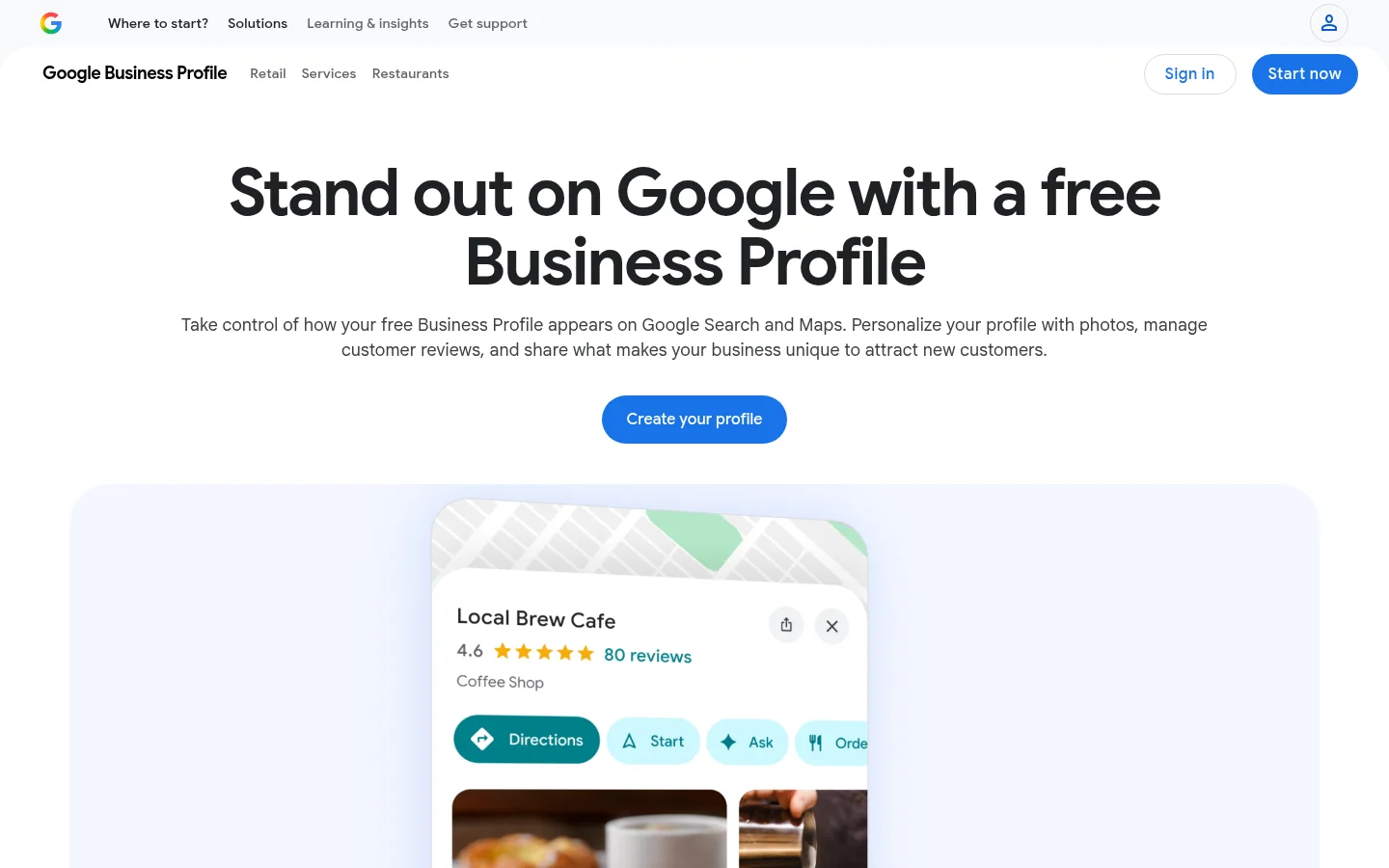
Work through the profile in this order:
- Claim it, and verify it with the method Google offers for your address.
- Pick the primary category that matches the work you want to win, then add secondary categories for the rest.
- Set your service areas by town or postcode district, not just a radius.
- List each service by name, in the words a customer would use.
- Write a plain description. Say what you do, who you do it for and where.
- Add photos of real jobs, your team and your premises. Name the files sensibly.
- Reply to every review, good or bad, within a few days.
Keep the profile accurate when things change. Holiday hours and a new service area are the two changes most often left out.
Write service pages that state who you serve, where, and what it costs
A service page is where the assistant gets the detail it needs to recommend you for a specific job. A generic page that says 'we offer quality services for all your needs' gives it nothing to work with. A page that says exactly what you do, for whom, and where, gives it something to match.
Use this checklist for each core service:
| Element | What to write | Example line |
|---|---|---|
| Service | The exact job, in customer language | Emergency boiler repair |
| Location | Towns and postcode areas you cover | Croydon, South Norwood and Thornton Heath |
| Audience | Who the service is for | Homeowners and landlords with a gas-safe engineer on call |
| Price range | A from-price, or what the price depends on | From [your price], depending on parts and access |
| Proof | Accreditations, years trading, review count and a link to reviews | Gas Safe registered, with a link to your Google reviews |
On price, give a from-price where you can. Where the cost really depends on the job, say what it depends on, such as size, access, materials or the level of testing. An honest range is more useful to the assistant and to the buyer than a vague 'get in touch for pricing'. If your site needs rebuilding to do this properly, our websites and apps service covers service pages built to convert, and our growth marketing service covers the content behind them.
Generic page or specific page
Generic page
- "We offer quality services for all your needs"
- Nothing about the job, the customer or the area
Specific page
- Says exactly what you do
- Says who you do it for
- Says where you do it and what it costs
The specific page gives the assistant something to match against a real request.
Earn reviews on the platforms AI tools pull from
Reviews are one of the sources ChatGPT draws on that you can actually influence (ClickForest). They also do a job for the human reading the answer, which is usually the point.
Ask for reviews at the right moment, which is when the customer is happy with the result, usually just after the job is signed off. Send a direct link to your Google review page by text or email, rather than asking them to search for you. Ask on the platform most relevant to your trade, which may be Google, a trade directory or a membership body. Respond to each review in your own words, and mention the service and town where it fits naturally.
Do not offer incentives that break platform rules, and do not post fake reviews. They are easy to spot and they can get your listing suspended. A steady flow of genuine reviews over time is worth more than a burst of them in a week.
Publish short, plain-language FAQ answers that match real customer questions
The questions a prospect types into an assistant are often the same ones they ask on the phone. Collect them from your enquiries, your email inbox, your live chat and your engineers or staff, who hear the awkward questions first. Aim for ten to twenty.
For each question, write the question as a heading and answer it in two or three plain sentences. Avoid jargon unless your customers use it. Put each answer on the service page it belongs to, not on a single FAQ page nobody visits. A question like 'How long does a boiler service take?' with a clear answer, and the honest caveat about what changes it, is exactly the kind of text an assistant can lift and use.
Keep the answers current. An FAQ that says you open at 8am when you now open at 7am undoes the work you did on your listings.
Get mentioned by reputable third-party sites and local directories
Your own website can only say so much. ClickForest lists third-party listicles, LinkedIn and editorial media among the sources ChatGPT recommends from (ClickForest). Okara makes a similar point: the goal is to get your brand named in the sources the assistant reads for your category (Okara).
For a local business, the realistic routes are these. Join the trade association or accreditation body that fits your work, and make sure your member page is current. Ask local suppliers, partners and clients who already know your work to link to you or name you in their own content. Offer a quote to local press or a trade publication when you have a genuinely useful view on a question. Sponsor or speak at a local event that gets written up online.
Do not pay for 'best of' listicles on sites you have never heard of. A mention on a weak site does little, and some of those sites are built to be ignored or removed.
How to measure progress and why no recommendation can be guaranteed
You can test your own visibility with a simple log. Write down ten questions a real prospect would ask. Examples: 'best [trade] in [town] for [job]', 'who should I call for [problem] in [area]', and 'is [your business name] any good'. Ask each one in a fresh chat with browsing on, and again with it off if the tool allows it. Record the date, whether your business was named, which competitors appeared, and which sources were cited. Repeat the same questions once a month.
The results will vary. The wording of a question changes the answer, the location you ask from can matter, the model version changes, and what has been crawled changes over time. A single good answer is not a trend, and a single bad one is not a verdict. Judge progress over several months, and track your enquiry numbers alongside the AI tests. A mention that brings no calls is not worth much.
No one can guarantee that ChatGPT will recommend your business. Anyone who promises a guaranteed placement is selling you something. What you can control is the accuracy of your listings, the clarity of your service pages, the number and quality of your reviews, the answers you publish, and the mentions you earn. Those five things make you easier to recommend. They do not make the recommendation certain.
Test your visibility
- 1
Write ten prospect questions
Use the forms a real customer would type, such as 'best [trade] in [town] for [job]' and 'is [your business name] any good'.
- 2
Ask each one in a fresh chat with browsing on
Start a new chat for each question so earlier answers do not affect the result.
- 3
Repeat with browsing off where the tool allows
Compare the two answers to see whether you appear from training, from live lookup, or not at all.
- 4
Log the results and check again later
Record whether you were named, where, and what was said. Repeat the same ten questions each month to see movement.
Where to start
- Write your master sheet of name, address, phone, hours and a two-sentence description, then check every listing against it.
- Claim, verify and fill in your Google Business Profile, including service areas and a reply to every review.
- Pick your three most profitable services and rewrite each service page with the who, where and price-range checklist above.
- Set up a simple review request that goes out after every completed job.
- Build your ten-question test log and run it this month, so you have a baseline to measure against.
If you want a straight view of where AI and search fit your business before you spend anything, get a free AI plan from us. We build, automate and grow businesses across the UK, MENA and the US, and the plan will show you which of these steps matter most for your trade. If you would rather talk it through, you can book a call with one of our strategists.
Sources
See it in practice

Built by Pensact
Go Way · A ride-hailing app for Egypt where riders pick the offer that suits them, across car, scooter or tuk-tuk. We built its systems and CRM.
Questions people ask
Do AI tools recommend local businesses?
Yes, they can. ChatGPT draws on structured sources such as Google Business Profiles, online reviews and directories, so a local business with consistent, well-maintained listings has a fair chance of being named. Whether it is named for any given question depends on the wording, the location and what the tool has seen, so there are no guarantees.
Do Google reviews affect AI recommendations?
Reviews are one of the sources ChatGPT recommends from that a business can influence, according to ClickForest. We cannot tell you how much weight a review carries in a specific answer, and nobody outside the tool's makers can. Steady, genuine reviews on the platforms your customers use are still worth collecting, for the assistant and for the people reading.
How can I check whether ChatGPT already mentions my business?
Write ten questions a real prospect would ask, such as best provider for a specific job in your town, and put them to ChatGPT in a fresh chat. Log whether your business is named, which competitors appear and which sources are cited. Repeat the same questions monthly and judge the trend over several months, not one answer.
What should my website say so AI can understand it?
State exactly what you do, who you do it for, and the towns or areas you cover, in plain language. Give a from-price or explain what the price depends on, and put your contact details in the same form as your listings. Answer the real questions your customers ask, in two or three sentences each, on the service page they relate to.
Keep reading
AI automation agency pricing: retainer, project or per workflow?
Project fee, retainer, usage or outcome? Here is how each AI automation pricing model bills, who carries the risk, and how to compare quotes over 12 months.
Noah Hany · 4 Nov 2026
The best AI automation tools for small business in 2026
The best AI automation tools for small business, grouped by job, with where each one breaks and when you need a custom build instead.
Noah Hany · 3 Nov 2026
AI automation agency vs in-house team: which fits your business?
Agency or one in-house hire? We compare cost, speed, control and risk, then give you a plain rule based on revenue, backlog and who will manage the work.
Noah Hany · 3 Nov 2026