AI & Automation
8 min readAI automation agency USA: what a small firm should pay
Whether an AI automation agency USA firm is worth its fee depends on how often the same work repeats in your business. Here is how to tell, and what a small firm should expect to pay.
Whether an AI automation agency USA firm is worth its fee depends on one thing: how often the same work repeats in your business. Most owners with 2 to 30 staff lose hours each week to enquiries that sit unanswered, quotes typed from scratch and reports nobody reads. This guide sets out what an agency builds, what a few tools can do on their own, and what a sensible budget looks like.
What an AI automation agency actually builds for a small business
An AI automation agency looks for repetitive work and builds software that does it. Typical targets are data entry, lead follow-up, reporting and document handling. AI Automation Agency USA describes its work this way: AI agents, workflow automations, voice agents and internal tools, built on platforms such as n8n, Zapier, Make, AppSheet and Power BI, with a fixed quote and working software in weeks (AI Automation Agency USA).
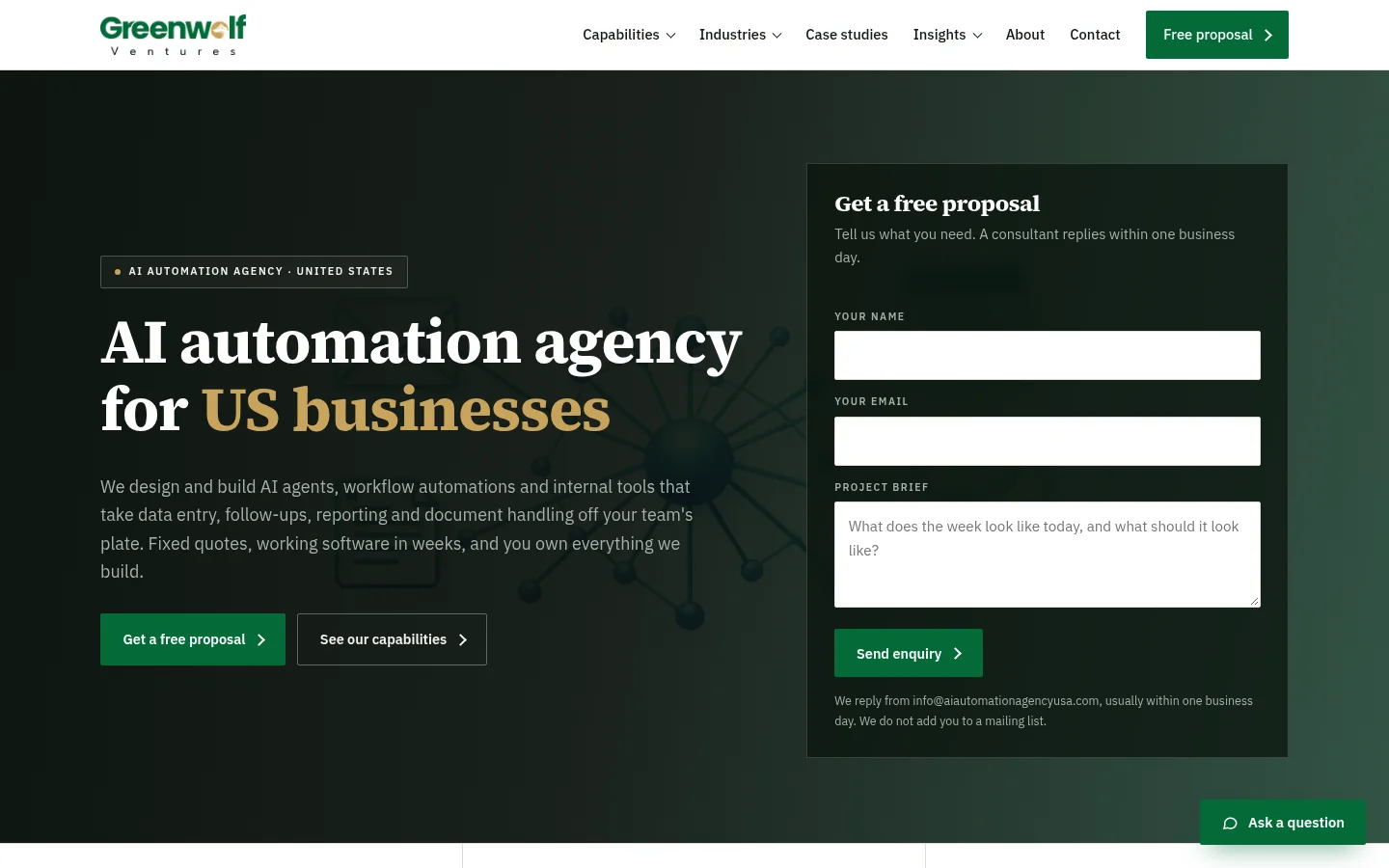
That is different from advice. A good agency does not hand you a list of tools to try. It maps a process, connects your forms, inbox, CRM and spreadsheets, writes the logic, tests it on real cases and leaves you with a flow that runs without you. Some agencies also build a chatbot or voice agent on top, but the core value sits in the plumbing between your systems.
Scope matters more than the label. An agency that only sells you a 'strategy' and a Zapier subscription is not building anything. Ask what will run after launch, where it runs and who can change it.
Where a few off-the-shelf AI tools are enough, and where an agency earns its fee
You do not need an agency for everything. If one tool already does the job, buy it and learn it. Hiring a build team to set up a shared inbox is a waste.
An agency earns its fee when the work crosses several systems, when the logic has exceptions your staff handle by memory, or when a mistake costs you a customer or money. Flexlab, quoted by The Des Moines Register, advises businesses to start with one clear workflow, reliable data and measurable outcomes rather than automating everything at once (Flexlab via The Des Moines Register).
| Situation | Buy tools yourself | Hire an agency |
|---|---|---|
| One app to one app, simple rules | Usually enough | Overkill |
| Three or more systems, shared data | Possible, but fragile | Often worth it |
| Staff already know the process | Start here | Only if volume is high |
| Exceptions and approvals | Manual workarounds pile up | Logic built in, tested |
| Nobody has time to maintain it | Risky | Maintenance agreed up front |
| Budget under a few hundred dollars a month | Yes | Only for a fixed-price build |
Two honest checks before you decide. First, can you name the task, how often it happens and how long it takes? Second, would you notice if the automation broke on Monday morning? If you cannot answer both, map the process first. Our guide on how to brief an AI agency so you get a fair quote covers that mapping step.
Buy a tool or hire an agency?
Buy the tool and learn it
- One existing tool already does the job
- The work sits inside a single system
- Your staff can follow the steps without help
- A mistake is cheap to fix
Hire an agency to build it
- The work crosses several systems
- Logic has exceptions your staff handle by memory
- A mistake costs you a customer or money
- You want the build owned and supported after launch
If one tool covers it, buy it. Bring in a build team only when the job spans systems or carries real risk.
Intake and follow-up: the first workflows to automate
For most small firms, the fastest payback sits in intake and follow-up. A lead arrives by web form, email, WhatsApp or phone. Someone copies it into a CRM, sends a reply, sets a reminder and, if nobody answers, chases again. Each step is small. Together they eat hours and let leads go cold.
A first build usually covers four things: capturing every enquiry into one place, sending an instant acknowledgement with the next step, scoring or tagging the lead, and triggering follow-ups at set intervals until the lead replies or is closed. Support is a similar case. Our article on AI customer support for small business: where to start goes through the order to build it in.
One vendor, AI Automation Agency 360, reports that clients saw up to 63% fewer support tickets, 60%+ faster response times and 40% less manual data entry (AI Automation Agency 360). These are that vendor's client-reported figures, not independently verified results. Treat them as a reason to measure your own baseline before you start, not as a forecast.
Before building, record three numbers for two weeks: how many enquiries arrive, how long the first reply takes, and how many leads go quiet. Those become your measures of payback.
How a lead moves through intake
Arrival
Web formEmailWhatsApp or phoneRecord
Lead copied into the CRMReply
Reply sentReminder setChase
No answer, so follow up againQuoting and reporting: what an agency builds and what you keep
Quoting is where many firms lose time and accuracy. The agency's job is usually to pull the job details from the enquiry, apply your price rules, generate a draft quote or proposal, and send it for approval. You keep the final say on price and on any unusual job. Quoting for trades is a good example of the pattern, which we cover in AI automation for tradespeople: quotes, jobs and invoices.
Reporting follows the same logic. A flow pulls figures from your CRM, accounting and ad platforms into one dashboard, usually in Power BI, AppSheet or a spreadsheet, and refreshes it on a schedule. What you keep is the judgement: deciding which numbers matter, what to do when they move and whether the rules still reflect how you sell.
Ask the agency to show, in writing, which parts are automated and which still need a person. A quote that promises to automate quoting entirely, with no approval step, is a warning sign for most small firms.
How much an AI automation agency costs in the US (estimates)
What the cost depends on is clearer than the price itself.
The main inputs are:
- Number of systems connected. Each extra tool adds integration work and testing.
- Complexity of the rules. Simple if-then logic costs less than multi-step approvals with exceptions.
- Volume and risk. A flow that sends customer messages needs more testing than an internal report.
- Build versus retainer. A one-off build is priced differently from ongoing maintenance and improvements.
- Tool subscriptions. These are usually billed separately, to whichever account holds the platform.
For reference points, AI Systems and Automation at Pensact starts from $499 with a build time of 1 to 3 weeks, and The Agency retainer runs from $499 to $2,999 a month, set by scope and agreed before we start. Other agencies publish different models. XRAY Tech, listed by Lumay.ai, is priced at $250 an hour for teams already on Zapier and Airtable (Lumay.ai, 10 Best AI Automation Agencies in the USA (2026)). An hourly rate can suit a small, well-defined fix, but it makes the final bill hard to predict. Our piece on why hourly rates break for small business explains the risk.
Example: estimated first-year cost of a lead intake build (made-up numbers)
The figures below are invented to show the method. They are not Pensact prices or a quote for your business. Replace each input with your own quote and tool bills.
Inputs:
- One-off build fee: $1,200
- Tool subscriptions: $180 a month
- Support retainer: $150 a month
- Months in the first year: 12
Calculation:
- Tools across the year: $180 × 12 = $2,160
- Support across the year: $150 × 12 = $1,800
- First-year total: $1,200 + $2,160 + $1,800 = $5,160
Now the saving side, also invented. Suppose the flow saves 6 staff hours a week at an assumed loaded cost of $35 an hour.
- Weekly saving: 6 × $35 = $210
- Monthly saving: $210 × 52 ÷ 12 = $910
- Monthly running cost: $180 + $150 = $330
- Net monthly gain after running costs: $910 − $330 = $580
- Payback on the build fee: $1,200 ÷ $580 ≈ 2.1 months
If your real saving is half that, the payback roughly doubles. That is why the baseline measurement matters.
How to choose an agency: fixed quote, ownership of the build, and ongoing support
Three things separate a sound agency from a risky one.
First, a fixed quote for a defined scope. Ask for the list of workflows, the systems they touch, what is excluded and what a change request costs. A fixed price does not mean a cheap price, but it stops the bill drifting.
Second, ownership. Ask who holds the accounts the automations run on, whether you receive exported flow files or code, where they are stored and whether you can move them to another provider. Ask who holds the login credentials and how they are handed over at the end. Some agencies run everything inside their own accounts, which can leave you stuck if the relationship ends. Check the answers in writing before you sign.
Third, support after launch. A flow that works today can break when an app updates its API. One recruiting agency owner on Reddit said they wanted an ongoing partner rather than a one-time consultant for marketing, sales and operations automation (Reddit r/automation). Decide up front whether you want a retainer, a support hour allowance or a handover to in-house staff.
Our checklist on how to check AI agency reviews before you hire helps you test the claims behind the testimonials.
Red flags and questions to ask before you sign
Watch for these signs:
- A price with no list of workflows or systems in scope
- Promises of full automation of judgement calls, with no approval step
- Accounts, logins or data held only in the agency's name
- No plan for monitoring, error alerts or fixes after launch
- Testimonials with no named client, no measurable outcome and no way to verify it
- Pressure to sign before you have mapped your process
Questions to put to every agency:
- Which workflows will you build first, and why those?
- What is the fixed price, and what would trigger a change in it?
- Whose account does each tool run under?
- What do I receive at handover, in what format?
- What is included in support, and what costs extra?
- How will we measure payback, and when will we review it?
Where to start
- Write down the three most repeated tasks in your week and how long each takes.
- Measure your current first-reply time and the number of enquiries that go quiet over two weeks.
- Choose one workflow, usually intake and follow-up, and set a payback target.
- Get two or three fixed quotes against the same written scope.
- Ask for ownership and handover terms in writing before you agree to anything.
If you want a clear view before you spend, start with the Free AI Audit, a 30-minute call that lists the tasks AI could take over in your business and gives you a step-by-step plan to keep. You can also get a free AI plan built around your own workflows, or book a call to talk through whether an agency or a set of tools makes more sense for your firm. Our AI systems and automation service covers the build side if you decide to outsource.
Sources
See it in practice

Built by Pensact
Go Way · A ride-hailing app for Egypt where riders pick the offer that suits them, across car, scooter or tuk-tuk. We built its systems and CRM.
Questions people ask
Is an AI automation agency worth it for a small business?
It is worth it when the same work repeats across several systems and a mistake costs you money or customers. If one off-the-shelf tool already does the job, buying it is usually the better choice. Measure the hours a task takes now, so you can check the payback after launch.
How much does an AI automation agency cost in the US?
The cost depends on how many systems are connected, how complex the rules are, how much volume the flow handles and whether you want a one-off build or a retainer. Pensact lists AI Systems and Automation from $499 with a 1 to 3 week build, and its monthly retainer runs from $499 to $2,999 set by scope. Tool subscriptions are usually extra.
Should a small US business hire an AI agency or buy tools?
Buy tools for simple, single-system tasks that your staff can manage. Hire an agency when the work spans several systems, has exceptions that need built-in logic, or nobody on your team has time to maintain it. Get a fixed quote for a written scope and compare it with the cost of the tools you would otherwise run yourself.
Who owns the automations and data after an agency builds them?
It depends on the contract and on which accounts the tools run under. Ask whether the flows run in your accounts or the agency's, what files or documentation you receive at handover, how credentials are passed on and whether you can move the build to another provider. Get those answers in writing before you sign.
Keep reading
AI customer support for small business: where to start
Which customer messages can AI take over safely, what needs a person, and how to hand off without trapping anyone in a loop.
Noah Hany · 14 Nov 2026
AI automation for restaurants UAE: the admin you can hand off
Owners of one or two UAE restaurants lose hours a week to admin. Here are the five tasks AI can take on, the order to tackle them and what setup asks of you.
Noah Hany · 12 Nov 2026
AI agent liability UK: who pays when an agent gets it wrong
An AI agent cannot be sued, so the business that deploys it usually carries the liability. Here is what to control before the next mistake.
Noah Hany · 12 Nov 2026