Stories
7 min readMobile app for food business: what to build first
A mobile app for food business is worth it only after customers prove they will order direct. Here is the order to build in.
Is a mobile app for food business worth the build cost? For most food, grocery and retail owners in the Gulf, it pays only once you have shown that customers will order from you directly, and only for the features that make a repeat order easy. This guide sets out what to build first, how to test before you spend, and where the risks sit.
Is a mobile app for food business worth it in the Gulf?
Start with a simple question: how do people order from you now? If most orders already come through a marketplace, a phone call or a social message, the app's job is to move those customers onto a channel you own. If nobody is ordering yet, an app will not create demand on its own.
The case for an app rests on friction. ChowNow, which sells ordering software to restaurants, argues in Why Every Restaurant Should Have a Mobile Ordering App that diners now expect to order from their phones, and that a branded app removes phone calls, marketplace clicks and the hunt for your website. That is a vendor's view, so treat it as a reason to test, not as proof. A more useful point comes from Railwaymen's article on foodservice apps, which notes that automation lets venues handle more orders than they can take by phone. For a busy kitchen or shop, the gain is capacity as much as convenience.
Vendors also quote revenue figures. Activemenus, which sells branded apps, reports in its guide on the mobile app revolution that one restaurant's branded app, Golden Dragon, earned 67% more revenue per customer than third-party platforms, and that its customers ordered 2.3 times as often. That is one vendor-reported example, not a study. Use it to frame your own question: what does a direct order earn you compared with one that passes through a marketplace?
Which features to launch with first: ordering, menus and order tracking
Published feature lists for food ordering apps are long. A LinkedIn guide to building a food delivery app lists registration, restaurant listings, menu browsing, search and filters, cart and secure checkout, multiple payment options, real-time order status, order history, and ratings and reviews. Most of that can wait.
For a first release, keep three things. You need a menu that is accurate and loads quickly, a cart and checkout that takes payment without fuss, and an order status message that tells the customer when the order is accepted, ready and on its way or waiting for collection. Those three cover the job the customer opened the app to do. Order tracking is the feature people notice, and it cuts the 'where is my order' calls that eat staff time.
Account features such as profiles, order history and reviews help keep people coming back, but they add build time and customer data you must protect. Add them once ordering works and you can see that customers return. If you run a food truck or pop-up, location updates matter more. Delivery Concepts makes this point about keeping regulars informed of where you are, and for a mobile trader that may be the feature that brings people back.
Choose your payment route before you design the screens. Jotform says it lets you collect food orders and payments with no extra transaction fees, and that it connects to more than 40 payment gateways, including Square, Stripe and Authorize.Net. Check your own gateway's fees and the rules that apply in your country. 'No extra fees' from one tool does not mean your payment provider takes nothing.
How a first-release order flows
Find and order
Menu browsingSearch and filtersCart and secure checkoutPay and confirm
Payment optionsOrder confirmationTrack and return
Real-time order statusOrder historyHow to test ordering and loyalty before the full build
Before you commit to a full build, test ordering on a channel you already control. A website with an online order form, or a free order-taking tool, will tell you quickly whether customers will order direct. Track three numbers for four to six weeks: direct orders per week, the share of customers who order a second time, and the average basket value. Those numbers become the spec for the app.
Loyalty is the second test. Offer a simple reward on a paper card or a basic points sheet before you code a points system. If customers will not fill in a card, a digital scheme will not change their habits. If they do fill it in, you have the design you need: the reward level, the visits required and the expiry rules.
Set the pass mark before you start, not after. Write down the number of direct orders per week that would cover the app's running costs and the marketing you would spend to bring people to it. If the test misses that line, you have saved the cost of a build. If it clears it, you can build with confidence. Our guide to when to build a custom app sets out three tests to run before you spend.
Test direct ordering before you build
- 1
Put an order form on a channel you control
Use your website or a free order-taking tool. Customers should be able to order without leaving your site.
- 2
Track two numbers for four to six weeks
Record direct orders per week and the share of customers who order a second time.
- 3
Build only if direct orders hold
If the numbers grow, the app has demand behind it. If they stay flat, fix the offer before you spend on an app.
Where the revenue case comes from: direct orders versus third-party platforms
Revenue from an app comes from three places: more orders, bigger baskets and fewer marketplace commissions. Work out the margin on each channel rather than the headline sales figure. A marketplace order costs you its commission. A direct order costs you the marketing that brought the customer in, the support you give them, and any delivery you pay for.
Write the sum down. Take the commission on a typical marketplace order, subtract the cost of bringing a customer back through your own channel, and multiply by the number of direct orders you expect each month. Then take away the monthly running costs of the app and the amortised build cost. What is left is the monthly gain, if there is one. Compare that with your test data, not with the vendor's percentage.
Getting people to download and order is also a marketing job. An app with no one telling customers about it earns nothing. Our growth marketing service covers that side, from search and email to paid campaigns, so the app has customers from the start.
Platform and vendor risks to check before you commit
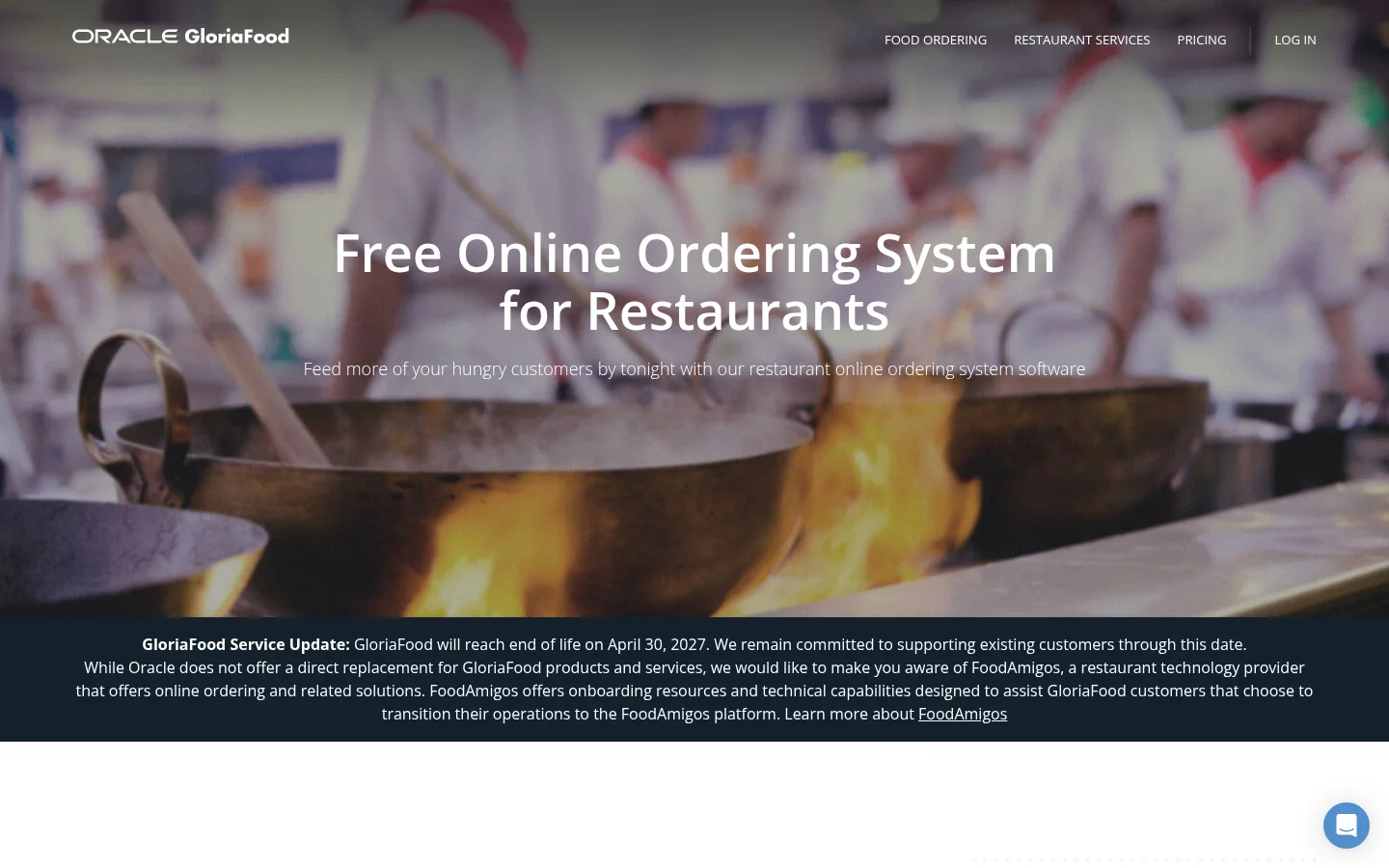
Before you choose a platform, ask who owns the app, the code and the customer data, and what happens if the vendor changes its terms or closes. GloriaFood, a free online ordering tool used by many restaurants, states on its website that it will reach end of life on April 30, 2027. Oracle does not offer a direct replacement for GloriaFood's products and services, and FoodAmigos is offered as a transition option. If you launched on GloriaFood today, you would need a migration plan in place well before that date. Most comparison pages do not mention this.
Other checks are practical. Ask whether you can export your order and customer data in a usable format. Ask who holds the app store accounts in your name. Compare monthly fees with per-order fees over a year, not a month. And check whether the platform connects to your kitchen display, your stock system or your accounts, because a manual copy-and-paste step will eat the time you hoped to save. Our guide to choosing an app development agency in MENA sets out what to ask a builder.
What to cut or defer in a first release
Cut anything that does not affect the order itself. The usual candidates are reviews, multiple loyalty tiers, in-app chat, personalised recommendations and multi-branch management if you run a single site. Each one adds test work and a support question on day one.
Ship the three-step order and the status messages first. Add accounts once repeat use shows up, and add the full loyalty scheme once the paper or simple version has proved itself. Run one platform and one payment route at launch, and add the rest when the first version is earning.
How long an app build takes in Saudi Arabia
Build time depends on scope, and the only reliable figure is a fixed quote against a written feature list. Pensact's published range for websites, apps and software is 2 to 6 weeks, starting from $990 at a fixed price. A menu and ordering app with payments, tracking and a loyalty scheme needs more than a basic menu app, and every integration with your gateway, kitchen or stock system adds time. We work across MENA from Cairo, Riyadh and Dubai, so the team that quotes you can plan around local payment and launch steps.
When you get a quote, ask for the launch date in writing, and check it covers testing, app store submission and a support period after launch. A low price with no test phase is the expensive option.
If you are not sure whether a full app or a simpler ordering channel fits your business, get the free AI plan or book a call with our team. We will look at how customers order from you now, what the first version needs to do and what it should cost to find out.
Sources
- Why Independent Restaurants Need a Mobile App
- Why Every Restaurant Should Have a Mobile Ordering App
- How Mobile Apps are changing the Foodservice Industry? | Railwaymen
- How to Develop a Successful Food Delivery App in 2026: From Business Idea to App Launch
- Why You Need a Mobile App for Your Food Truck
- GloriaFood Online Ordering: Free Online Ordering System for Restaurants
- Create Free Online Food Ordering System
See it in practice

Built by Pensact
Wtrmelon · A brand we worked on and partnered with: streetwear with a story, shipped worldwide from Germany and Dubai.
Questions people ask
Is a mobile app worth it for a food business?
It is worth it once customers already order from you, or would order direct if the channel were easier. Test direct ordering on a website or a free order form first, and compare the margin on each direct order with the marketplace commission you pay now. If the gain covers the app's running costs and marketing, the build case is real.
What features should a food business app have first?
Start with an accurate menu, a checkout that takes payment cleanly, and order status messages from accepted to ready or out for delivery. Those features handle the job customers open the app for. Add profiles, reviews and a full loyalty scheme once repeat use shows up.
What is the best app to sell food?
There is no single best app, because the right one depends on whether you need your own branded app, a marketplace listing or a simple order form. Check the platform's fees, data export rights and end-of-life dates before you choose. A free tool that is being retired can cost you more than a paid one that stays.
How long does it take to build a retail app in Saudi Arabia?
The timeline depends on scope, integrations and how quickly you sign off each stage. Pensact's published range for websites, apps and software is 2 to 6 weeks, from $990 at a fixed price, but an app with payments, tracking and loyalty will need more. Ask for a fixed quote against a written feature list and a launch date in writing.
Keep reading
AI billing model for small business: why hourly rates break
If AI cuts the hours a task takes, an hourly invoice shrinks with it. Here is how to rebuild your pricing around results, judgment and a fair share of the saving.
Noah Hany · 8 Nov 2026
Can AI replace staff in small business? A founder's honest view
Can AI replace staff in small business? Usually it takes tasks out of a role, not the whole role. Here is what that looks like in practice, and what to plan for.
Noah Hany · 7 Nov 2026
AI automation for restaurants UAE: the admin you can hand off
Owners of one or two UAE restaurants lose hours a week to admin. Here are the five tasks AI can take on, the order to tackle them and what setup asks of you.
Noah Hany · 12 Nov 2026