Growth
8 min readSales funnel for small business: a simple build that pays back
A three-step funnel for a service firm: a lead magnet, a follow-up sequence and a booking page, plus the numbers to check at each step and when to hold off.
A sales funnel for small business sounds like something only big marketing teams build. For a service firm it is simpler: one free thing people want, a short run of follow-up emails and a page where they book a call. The usual problem is not a lack of enquiries. It is not knowing where the enquiries stop.
What a sales funnel for small business means for a service firm
IBM describes a sales funnel, also called a marketing or purchase funnel, as a visual roadmap of the customer journey from first awareness to final purchase (IBM). Crazy Egg breaks the same path into four account statuses: lead, prospect, opportunity, and closed deals that are won or lost (Crazy Egg). Those labels are less useful than the events between them. For a service business, the event that moves someone from lead to prospect is usually a booked call, and the event from opportunity to client is a signed scope or a paid first invoice.
The number of stages depends on the size and shape of your business and your industry, according to IBM. So do not copy a nine-stage diagram from a software company. A service firm can run a useful funnel with three steps and a handful of numbers.
The top of the funnel is the first point of contact. A landing page is often where a prospect first learns what you do. People arrive from an ad, a social post, a link in an email, or a sign-up for a guide or webinar (Business News Daily). Your funnel is the set of pages and messages that sit between that first visit and a booked conversation.
How a funnel moves a prospect from first contact to close
Top: awareness
First awarenessVisitor finds youMiddle: qualifying
LeadProspectBottom: decision
OpportunityClosed deal, won or lostThe three steps: lead magnet, follow-up sequence and booking page
The build has three parts. Each one does a single job.
| Step | What you set up | What to check first | What a weak result tells you |
|---|---|---|---|
| 1. Lead magnet | A free checklist, short audit or template tied to the problem you solve, with a sign-up form | Share of visitors who sign up | The offer or the traffic is wrong |
| 2. Follow-up sequence | Four or five emails over about two weeks that deliver the magnet, answer one objection and link to one booking page | Share of sign-ups who open and click | The emails are generic or too long |
| 3. Booking page | One page, one action, a calendar slot and a short form | Share of leads who book a call | The page asks for too much or the next step is unclear |
Step one: the lead magnet
Make the free thing specific to the problem your client has before they hire anyone. For a bookkeeping firm that might be a one-page list of the five errors that cause a late VAT return. For a web studio it might be a page-speed checklist. Avoid a general newsletter. Nobody books a call because of a newsletter.
Jacinta Devlin describes a combination that works well for small firms: organic social content for awareness, a lead magnet to capture email, a nurture sequence to build trust, and a clear offer with a reason to act now (Jacinta Devlin). You do not need all four pieces on day one. Start with the magnet and one channel you already use.
Step two: the follow-up sequence
A sign-up with no follow-up is wasted. Write the sequence yourself first, so you know what you actually say. A simple five-email run looks like this: email one delivers the magnet, email two shows a mistake you see often, email three answers the main objection (usually cost or time), email four links to the booking page, and email five asks whether the timing is wrong. Keep each email short enough to read on a phone in under a minute.
Once the sequence works, you can automate the sending and the reminders. Automation should not replace a real reply when someone writes back. If a lead answers, a person should reply within one working day.
Step three: the booking page
The booking page should have no menu, no blog links and no second offer. It needs a headline that names the problem, two or three lines on what happens in the call, the length of the call, who will be on it, and a calendar. Ask for a name, a business, and one question. Every extra field lowers the number of bookings.
Paid ads and referrals should land here or on the magnet page, never on your homepage. Tag every link with its source so you can tell a referral from a Google ad. If you want outside help with ads and funnel pages, our growth marketing service covers both, and the appointment booking setup guide walks through the calendar side in more detail.
Numbers to track at each step
There are four numbers that matter for a three-step funnel:
- Visitors to sign-ups, which tells you whether the magnet and the traffic match.
- Sign-ups to booked calls, which tells you whether the sequence and booking page are working.
- Booked calls to proposals, which tells you whether your calls are qualifying the right people.
- Proposals to paying clients, which tells you whether your price and your offer hold up.
Check the first number that looks weak. If visitors rarely sign up, fix the magnet or the traffic before you touch the emails. If people sign up but never book, the sequence or the booking page is the problem.
We will not give you a healthy rate for each step. Those rates depend on your market, your price and your offer, and a figure lifted from someone else's business will mislead you. Instead, record your own baseline for four to six weeks, then change one thing at a time and compare.
Worked example: a made-up bookkeeping firm
The numbers below are made up to show the method. They are not from a real client.
Inputs:
- Visitors to the landing page each month: 500
- Share who sign up for the checklist: 10%
- Share of sign-ups who book a call: 20%
- Share of calls who become clients: 30%
- Monthly fee per new client: £400
The sum, line by line:
- 500 visitors × 10% = 50 sign-ups
- 50 sign-ups × 20% = 10 booked calls
- 10 calls × 30% = 3 new clients
- 3 clients × £400 = £1,200 of new monthly revenue
Now change one input. Suppose the booking page is rewritten and the booking share rises from 20% to 40%, with everything else the same:
- 50 sign-ups × 40% = 20 booked calls
- 20 calls × 30% = 6 new clients
- 6 clients × £400 = £2,400 of new monthly revenue
The same traffic produces double the revenue because one step changed. That is why you measure each step rather than only total sales.
How to measure the funnel end to end
Tag every enquiry with its source when it enters your inbox or CRM. Use a free CRM or a spreadsheet to record the date, the source, whether they signed up, whether they booked, whether they became a client, and the value of the work. Review it once a week for ten minutes.
If you run paid ads, add one more figure: cost per booked call, which is ad spend divided by booked calls from that ad. If that number is higher than what a booked call is worth to you, the ads are losing money, however good the clicks look.
You do not need a dashboard at the start. A spreadsheet with five columns, updated weekly, is enough to show you where the funnel leaks.
Tools to run it without a big budget
You need four things: a landing page, an email tool, a booking calendar and a simple CRM. The HubSpot CRM is free forever, with paid plans starting at $10 per seat per month (Shopify). A free CRM is enough for a small team that is only tracking leads and bookings. Move to a paid plan when you need automation, reporting or more seats.
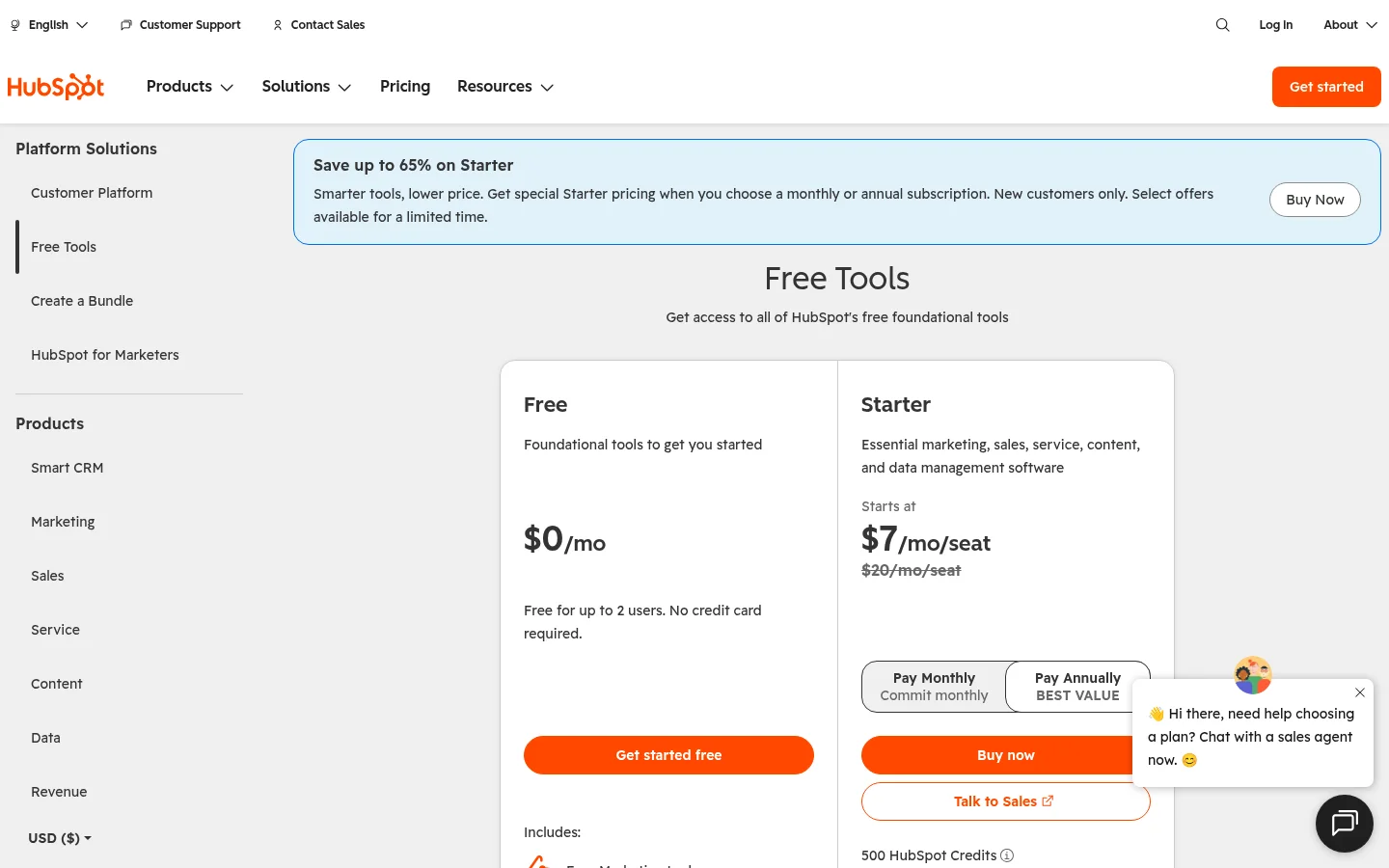
What each tool costs depends on how many people use it, how many contacts you store and which features you need. Compare the monthly price with the value of one client before you commit. If you are a solo owner, our piece on AI tools for solo business owners covers what to skip.
Free CRM or paid CRM
Free CRM
- Core HubSpot CRM is free forever
- Enough for a small team tracking leads and bookings
Paid CRM
- Plans start at $10 per seat per month
- Worth it when you need more than basic tracking
Start free while you only track leads and bookings. Move up when the tracking needs outgrow it.
When a funnel is not worth building yet
A funnel multiplies what you already do. If the base is weak, it multiplies the weakness. Hold off if any of these are true:
- You cannot name your last ten enquiries or where each one came from. Fix tracking first.
- You cannot describe your offer in one sentence a stranger would understand.
- You already cannot fit the work you have. A funnel will bring more enquiries you cannot serve.
- One client is worth little compared with the hours it takes to run the funnel. Work out the value of one client first, then decide whether the build pays.
- You have no referrals, no reviews and no clear result to show. Build those first.
If you are in that position, do the simple version: a clear offer, a booking link on your current site, and a follow-up message to every enquiry. Our look at whether AI can bring small business customers gives an honest view of what automation will and will not fix.
Build the funnel when all of these are true
Common mistakes that break a small funnel
- A magnet nobody asked for. Test it by asking three past clients whether they would have downloaded it.
- Too many links and too many offers on the booking page.
- No owner for follow-up, so leads go cold for a week.
- Sending paid traffic to the homepage.
- Counting sign-ups as success. A sign-up is only the first step.
- Building the funnel before the offer and the price are clear.
- Changing three things at once, so you cannot tell what worked.
Where to start
- Write down your last ten enquiries and where each came from.
- Write one specific free resource for the problem your best clients had before they hired you.
- Draft a five-email sequence that ends with one booking link, and send it to yourself first.
- Set up one booking page with one action, then record your conversion for four weeks before changing anything.
If you want a second pair of eyes on which step is leaking, get a free AI plan at /go/free-ai-plan or book a call at /book. We will look at your current enquiries, your follow-up and your booking page, and tell you which of the three steps to fix first and whether a funnel is worth building now.
Sources
See it in practice

Built by Pensact
Crumbly · A cookie brand baking in Egypt, built around the feeling of the first bite.
Questions people ask
What is a sales funnel for a small business?
It is the path a prospect follows from first hearing about you to becoming a paying client. For a service firm, that usually means a free resource, a short follow-up sequence and a page where they book a call. The aim is to see where people drop off, so you can fix that step.
How many steps should a small business funnel have?
Three is enough for most service firms: a lead magnet, a follow-up sequence and a booking page. The right number depends on your size, your industry and how your clients buy, so do not copy a long diagram. Add a step only when you can measure a clear gap it would close.
How do I measure a sales funnel?
Track the share of visitors who sign up, the share of sign-ups who book, the share of bookings who become proposals and the share of proposals who pay. Tag every enquiry with its source, and review the numbers weekly. Compare against your own baseline over four to six weeks rather than someone else's benchmark.
How can I create my own sales funnel?
Start with one specific free resource for your ideal client's main problem, then write a five-email sequence that delivers it and links to one booking page. Set up a simple CRM to track each lead, and send all traffic to the booking page rather than your homepage. Fix the weakest step before adding anything new.
Keep reading
Lead magnets that actually convert: a simple playbook
Most lead magnets fail because they're too big, too vague or too slow. Here's how to build one that people want, and the follow-up that turns them into clients.
Sam Luke · 29 Sept 2026
Intelligent process automation for small business: what it adds
Rule-based bots break on emails and PDFs. Here's what document reading and machine learning add, two small business examples, and when it's not worth it.
Noah Hany · 15 Nov 2026
Appointment booking automation small business: setup guide
A practical guide to setting up booking, deposits, reminders and rebooking in one week, for salons, clinics and trades that take bookings by phone and DM.
Noah Hany · 15 Nov 2026